Why Low-Oxygen Embryo Culture Depends on More Than a Gas Setting
Reduced-oxygen embryo culture can support stable conditions, but only when gas delivery, monitoring and workflow are properly controlled.
Why oxygen control matters
In vivo, embryos develop in an environment with oxygen levels well below atmospheric air. This is why many IVF laboratories use reduced-oxygen culture, typically around 5% O₂, rather than exposing embryos to room air at approximately 21% O₂. The aim is to provide a more physiologically relevant environment and to limit oxidative stress that may affect sensitive early developmental stages.
However, setting an incubator to a low oxygen value is only one part of the process. In practice, embryo culture outcomes depend on whether the entire gas pathway, from supply and mixing to chamber recovery and routine handling, can deliver stable and verified conditions day after day.
The role of the tri-gas mixer
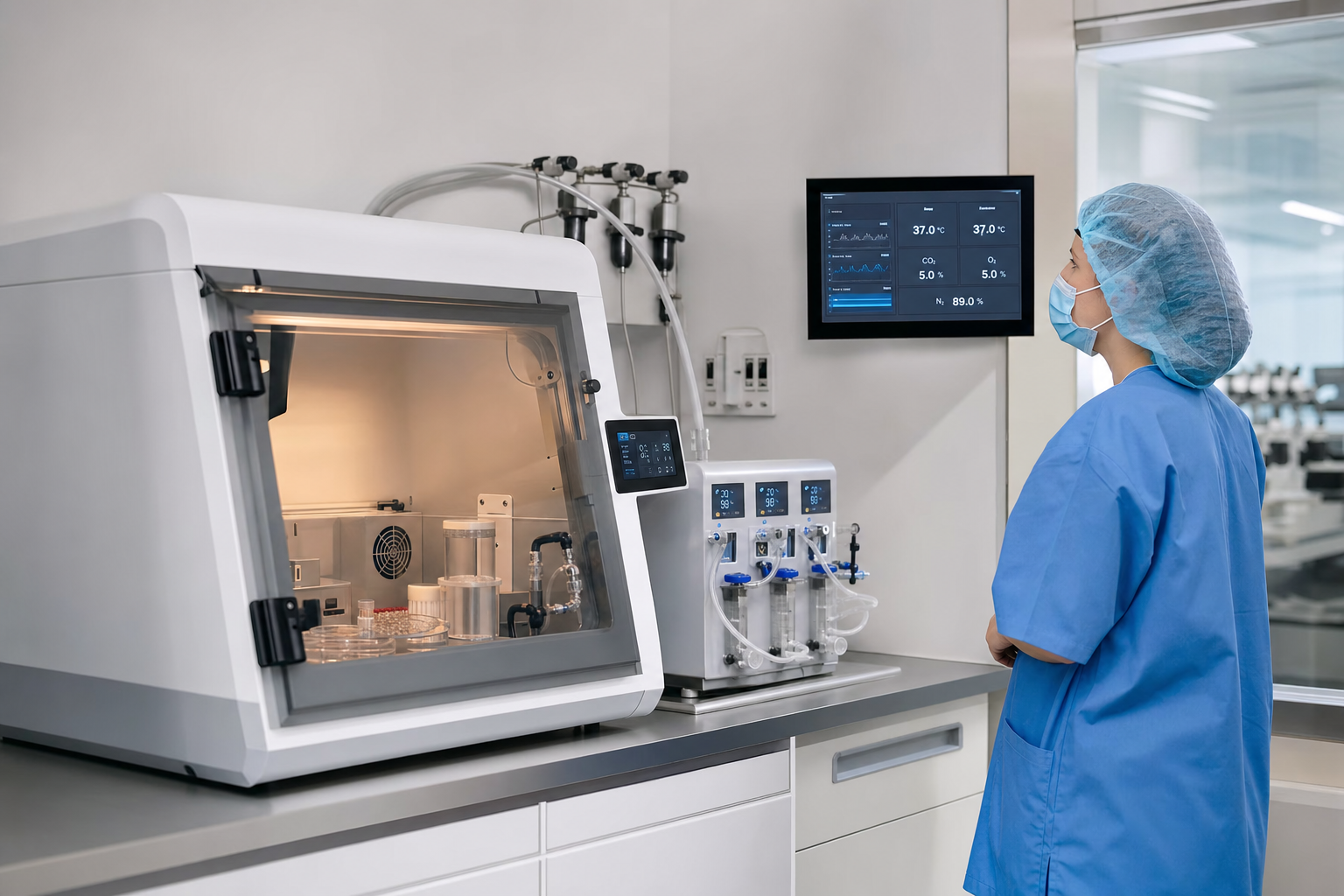
A tri-gas mixer blends nitrogen, carbon dioxide and air or oxygen to achieve the required chamber atmosphere. In IVF use, this usually means controlling both CO₂, which supports pH stability in bicarbonate-buffered media, and O₂, which defines the reduced-oxygen environment. If gas blending is inconsistent, the incubator may display a target value while the actual internal environment drifts or recovers too slowly after door openings.
For that reason, laboratories should view the tri-gas mixer as a process-critical device rather than a simple accessory. Accuracy, response time, compatibility with the incubator, alarm behaviour and serviceability all matter. A stable mixer helps create a stable incubator, and stability is often more important than headline specifications alone.
Recovery time and real workflow
One of the most overlooked aspects of low-O₂ culture is recovery after interruption. Each time an incubator door is opened, the chamber is exposed to room air. In a busy IVF laboratory, repeated access for checking dishes, moving patients’ material or performing observations can lengthen the time embryos spend outside target conditions.
When assessing performance, laboratories should ask not only what oxygen level can be achieved, but how quickly the system returns to set point after a typical opening. This should be considered under real working conditions, with normal loading patterns and routine door access. A technically excellent gas system can still underperform if workflow repeatedly disrupts the environment.
Verification, not assumption
Low-oxygen culture should be verified through qualification and routine monitoring. Displayed values alone are not enough for a critical process. During installation and periodic review, laboratories should confirm that oxygen and carbon dioxide values at the incubator chamber match expected performance, and that any deviations are investigated.
This also applies after maintenance, gas cylinder changes, pipeline work or relocation of equipment. Even small changes in supply pressure, leaks, calibration drift or room ventilation can affect delivered conditions. Written procedures for checks, acceptance criteria and escalation are therefore an important part of quality management.
The room environment still matters
It is easy to focus on the incubator and forget the room around it. Yet ambient temperature, ventilation patterns, foot traffic and the location of gas lines all influence system behaviour. A tri-gas setup installed in an unsuitable area may face preventable fluctuations or service difficulties.
Practical points include ensuring secure gas supply arrangements, protecting lines from damage, maintaining appropriate room temperature, and allowing access for routine servicing. In new or refurbished IVF laboratories, oxygen control should be considered early in the design phase rather than added later as an afterthought.
Human factors and handling discipline
Even with a well-designed system, poor handling practices can undermine reduced-oxygen culture. Teams should minimise unnecessary door openings, organise dishes and consumables before access, and align observation schedules to reduce repeated disturbance. If multiple users share one incubator, clear protocols become especially important.
Training should cover more than basic operation. Staff need to understand why oxygen control matters, what alarms mean, how to respond to supply issues, and which actions may prolong recovery. When users understand the process, they are better able to protect it.
When to review your setup
A review is worthwhile if culture conditions are inconsistent, if incubator recovery seems slow, if gas consumption is unexpectedly high, or if repeated alarms occur without an obvious cause. These signs may point to leaks, calibration issues, poor workflow design or mismatched equipment rather than a single isolated fault.
Regular review is also sensible when case volume increases or when a laboratory introduces new incubators, time-lapse systems or revised room layouts. Oxygen control should evolve with laboratory activity, not remain fixed while operational demands change.
A systems approach to embryo culture
Reduced-oxygen culture is best understood as a controlled system rather than a single setting. Gas source quality, mixing accuracy, incubator performance, room design, maintenance routines and staff practice all contribute to what embryos actually experience.
For clinic managers and laboratory teams, the key question is not simply whether low-O₂ culture is being used, but whether it is being delivered consistently, measured appropriately and supported by the wider laboratory environment. That is where reliable performance is built.
If needed, tech²ART can help assess equipment and workflow considerations for stable low-oxygen culture.