Why Medical Equipment Requires Specialised Design
Medical and laboratory equipment operates under strict constraints that generic product design firms cannot navigate. Temperature-critical storage at -86°C, sterile gas environments for embryo culture, high-speed rotor assemblies with vibration tolerances below 0.1mm; these are not standard engineering challenges.
tech²ART's design team brings deep domain expertise in medical equipment engineering. We understand the clinical workflows, the regulatory frameworks, and the manufacturing realities that shape successful medical devices.
Equipment types we design & engineer:
Core Design & Engineering Capabilities
Every capability is tailored for the medical equipment sector, not repurposed from consumer or industrial design.
Industrial & Mechanical Design
Enclosure design, ergonomic interfaces, and precision mechanical assemblies tailored to medical environments. Sterilisable materials, clean-room compatibility, and user-safe geometry.
Electronics & Firmware
Custom PCB design, embedded controllers, sensor integration, and real-time firmware for temperature control loops, motor drives, and safety monitoring in medical instruments.
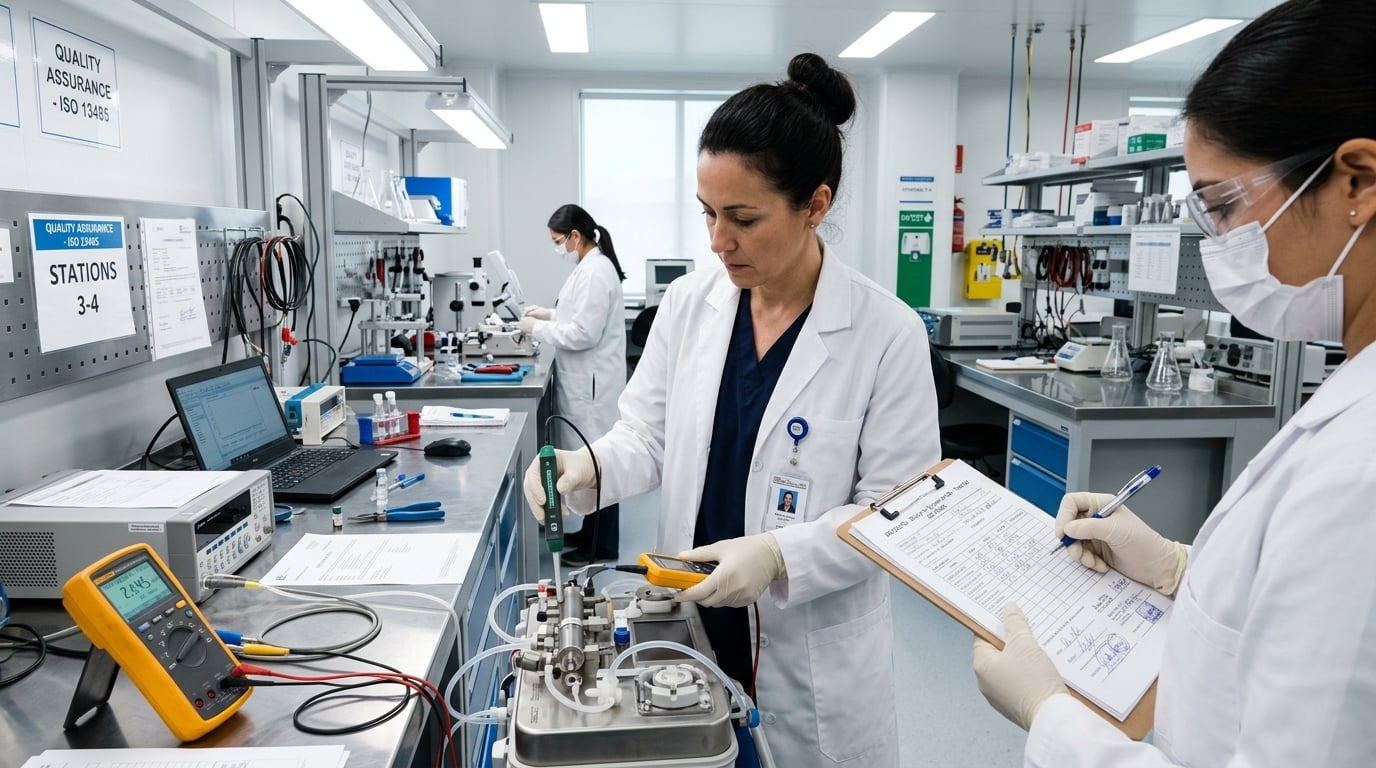
Rapid Prototyping & Testing
Functional prototypes using medical-grade 3D printing, CNC machining, and sheet metal fabrication, verified through accelerated life testing and clinical simulation.
CE / MDR Regulatory Compliance
Design documentation aligned with MDR 2017/745, IVDR, IEC 61010, and ISO 13485. We build compliance into the design from day one, not as an afterthought.
Design for Manufacturing (DFM)
Production-optimised designs that reduce assembly time, minimise tooling costs, and ensure consistent quality across batches, from 50 units to 5,000+.
Quality Management Integration
Design outputs structured for ISO 13485 QMS traceability: design inputs, risk analysis (ISO 14971), verification & validation records, and DHF documentation.
From Concept to Production
Our design process follows a medical device development lifecycle aligned with ISO 13485 and IEC 62304.
Requirements
User needs, clinical requirements, safety standards, and regulatory classification.
Architecture
System architecture, component selection, risk analysis, and design specifications.
Detail Design
3D CAD, PCB layout, firmware, and BOM, all with full design history file (DHF).
V&V Transfer
Verification & validation testing, design transfer package, and manufacturing documentation.