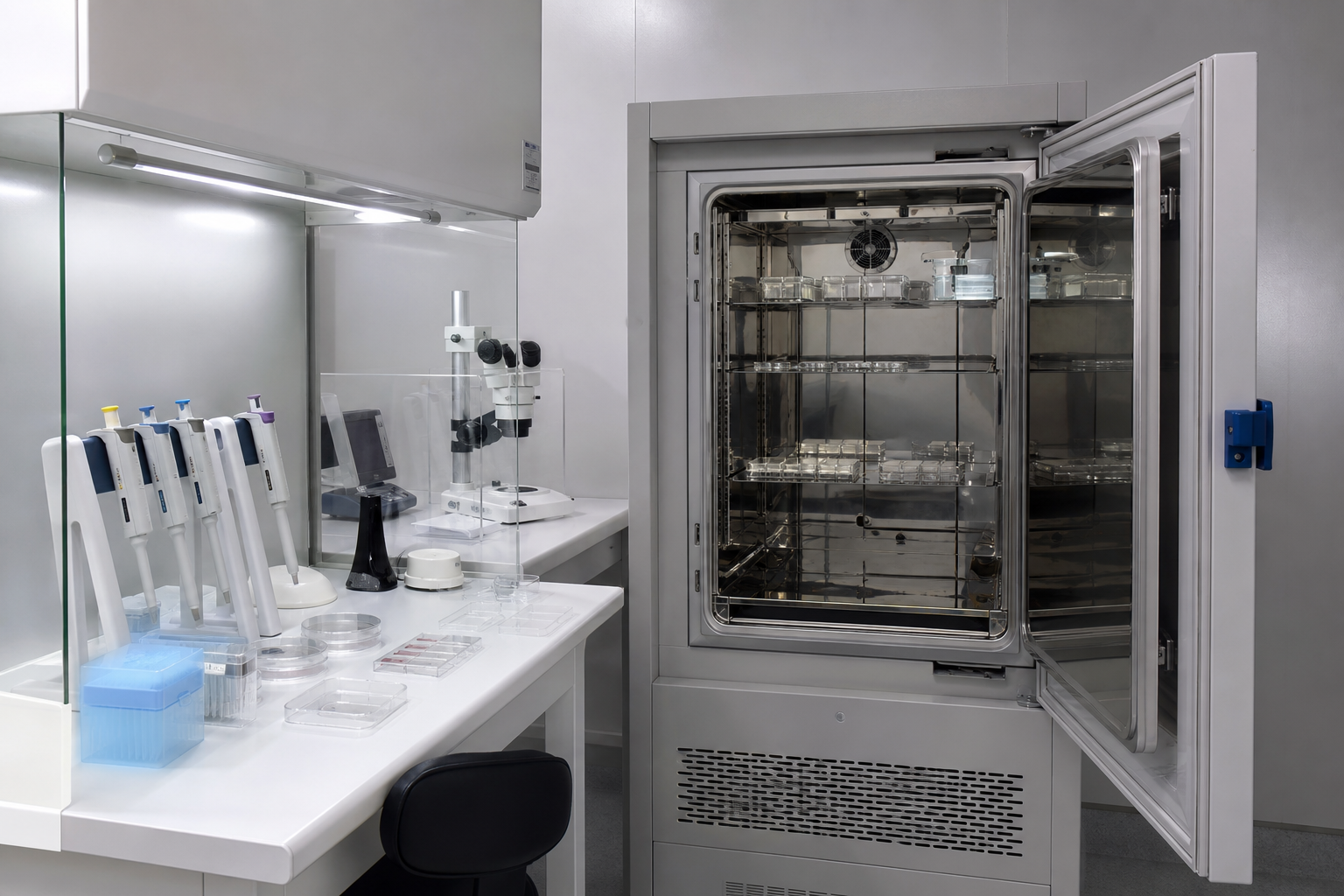
Managing Gas Quality in Reduced-Oxygen IVF Culture Systems

Stable low-O₂ culture depends on gas quality, delivery and verification as much as on incubator settings.
Why gas quality deserves more attention
Reduced-oxygen embryo culture is now routine in many IVF laboratories, yet discussions often focus almost entirely on the target oxygen percentage inside the incubator. In practice, embryos are affected by the whole gas pathway: source gas quality, pressure regulation, pipework, mixing accuracy, leak tightness, alarm handling and verification at the point of use.
When results are variable, laboratories sometimes look first at media, consumables or staff technique. These are important, but unstable or contaminated gas delivery can quietly undermine otherwise well-controlled culture conditions. A low-O₂ strategy is only as reliable as the system that produces and maintains it.
What “medical grade” does and does not guarantee
Gas cylinders and central supply are commonly described as medical grade or laboratory grade, but those labels should not be treated as complete assurance of fitness for embryo culture. The key questions are whether the specified purity is appropriate, whether impurities are controlled and documented, and whether the supply chain is consistent over time.
Trace contaminants can matter even when the main gases are within specification. For IVF use, laboratories should review supplier certificates, understand limits for moisture and other impurities, and ensure that any change of supplier or gas specification is formally assessed through change control. A gas that is acceptable for one clinical or technical application may not be ideal for sensitive culture work.
The hidden risks in the delivery path
A gas supply can begin clean and still reach the incubator in poor condition. Regulators, connectors, valves, hoses and manifolds all introduce potential failure points. Small leaks may not be dramatic enough to trigger immediate concern, yet they can affect mixture accuracy, create pressure instability and increase gas consumption.
Materials also matter. Components used in the delivery path should be compatible with the gases supplied and suitable for the laboratory environment. Ageing hoses, damaged seals and ad hoc fittings are common weak points. A tidy, standardised installation is not just easier to maintain; it is easier to verify and less likely to drift into unsafe or unreliable operation.
Why pressure stability matters to mixer performance
Tri-gas mixers are designed to blend incoming gases accurately, but their performance depends on stable inlet conditions. Fluctuating supply pressure can lead to inconsistent output, especially during periods of high demand or cylinder changeover. If several devices share one supply, pressure drops elsewhere in the network may influence the gas available to culture equipment.
For this reason, laboratories should consider not only nominal pressure settings but also how the system behaves during routine interruptions. Cylinder depletion, manifold switchover and maintenance work are all moments when instability can occur. Reviewing these scenarios in advance helps prevent brief but significant deviations in culture conditions.
Verification should happen at the point of use
A mixer display or incubator setting is not proof of the gas environment the embryos actually experience. Verification should take place where the gas is used, with calibrated measurement equipment and defined acceptance criteria. This may include checking oxygen and carbon dioxide levels after installation, after service, after cylinder or supplier changes, and at scheduled intervals during routine use.
Trend review is equally valuable. Single pass-fail checks can miss gradual deterioration, whereas trended data may show developing issues such as drift, delayed recovery or increasing variability between units. For busy IVF laboratories, these trends can be an early warning before clinical performance is affected.
Alarm strategy and staff response
Even a well-designed gas system is only as safe as the response it triggers when something goes wrong. Laboratories should decide which conditions require local alarms, remote notification or immediate escalation. Examples include low inlet pressure, abnormal outlet composition, failure to reach setpoint and prolonged recovery after door opening or service intervention.
Just as important is staff training. Team members should know what each alarm means, what immediate checks to perform and when embryos or gametes may be at risk. Clear, simple response instructions reduce hesitation during time-critical events and support consistent decision-making across shifts.
Change control in everyday operations
Many gas-related deviations arise not from major failures but from ordinary operational changes: a new cylinder batch, a replacement regulator, serviced incubator, moved bench or modified room layout. Each of these can alter system behaviour in subtle ways.
A practical change-control process should require documentation of what changed, what risks were considered, what tests were completed and who approved return to routine use. This approach is especially useful in multi-room IVF facilities, where one local intervention can have effects elsewhere in the gas network.
A sensible audit checklist
For laboratories reviewing their current setup, a few questions are often revealing. Is the gas specification documented and justified? Are regulators and hoses standardised? Is there a defined verification schedule at point of use? Are alarm limits and responses written down? Are supplier or component changes formally assessed?
If the answer to several of these is no, the issue may not be the culture concept itself but the control of the system supporting it. Good embryo culture relies on environmental consistency, and gas quality management is a central part of that consistency.
A robust low-O₂ culture programme depends on more than selecting the right target value. tech²ART can help laboratories review the practical details that keep gas delivery stable, verifiable and fit for routine IVF use.