Managing pH Stability in Embryo Culture: The Overlooked Variable in IVF Labs
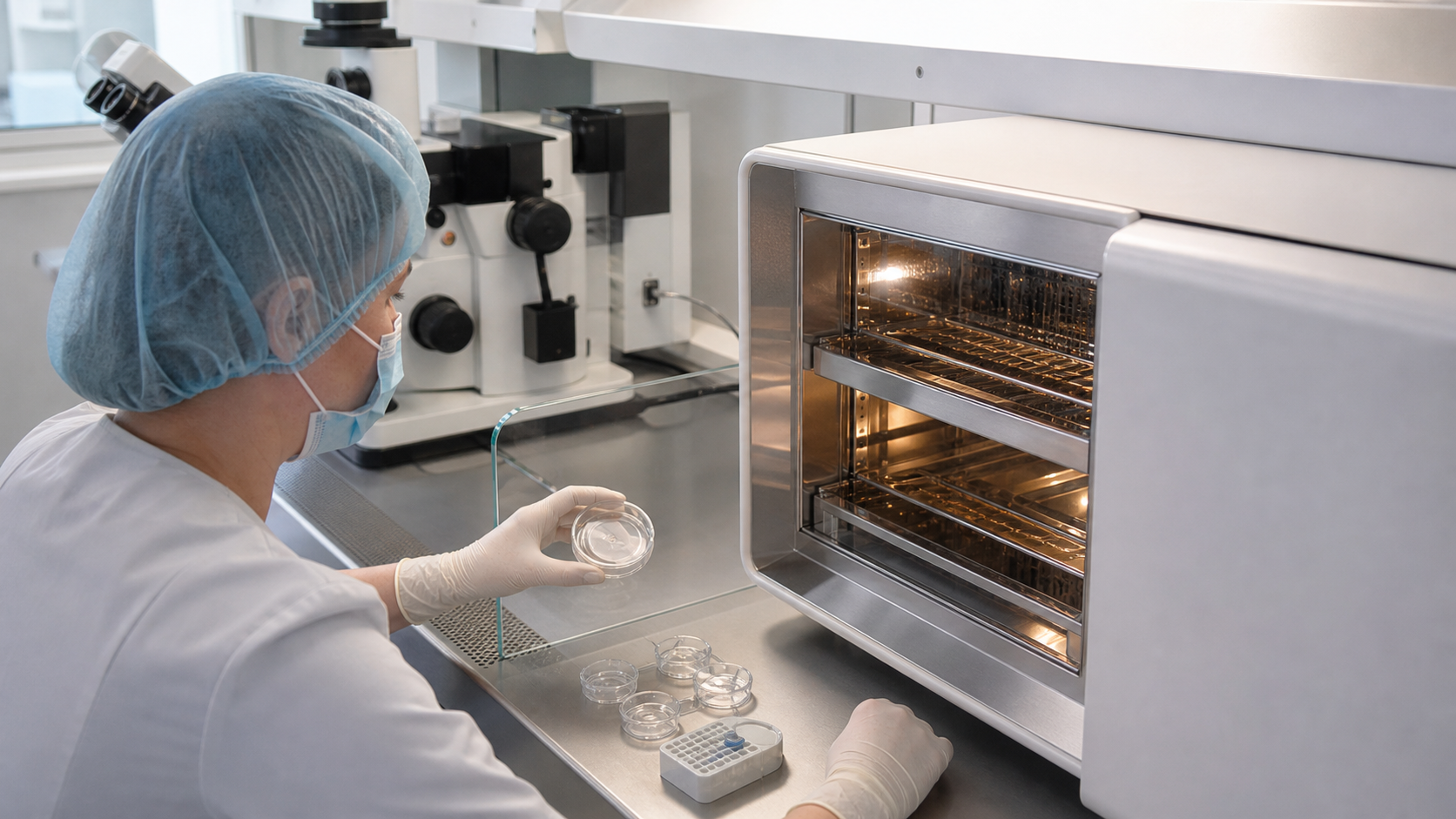
Small pH shifts can affect embryo culture; robust control depends on media handling, gas delivery, workflow and equipment verification.
Why pH deserves more attention
Temperature and gas control are discussed routinely in IVF laboratories, yet pH stability in embryo culture is often treated as a secondary outcome rather than a parameter requiring its own control strategy. In practice, pH is highly dynamic. It changes with CO₂ concentration, media composition, temperature, oil overlay performance and, critically, the way dishes are prepared and handled during daily work.
For embryologists, this matters because embryos are exposed not to the incubator setting on a display, but to the actual micro-environment in the culture droplet. Even short excursions outside the intended pH range may alter cell physiology, metabolism and developmental competence. A stable process therefore depends on understanding where pH drift begins and how to limit it.
Where pH instability starts
Most bicarbonate-buffered IVF media rely on equilibrium with a defined CO₂ atmosphere. If that equilibrium is disturbed, pH shifts quickly. One common cause is prolonged dish preparation on the bench before the media has equilibrated properly. Another is repeated removal of dishes from the incubator during assessment or manipulation.
Temperature also plays a role. Media taken from a controlled incubator into a cooler room environment may experience simultaneous thermal and pH change. The effect is not always obvious, because a dish can appear acceptable while the droplet chemistry is moving away from target conditions. This is one reason why open-door time, workstation layout and handling discipline all influence culture consistency.
The link between gas control and real culture conditions
A CO₂ setpoint is not the same as verified pH control. Actual conditions depend on whether the incubator reaches and maintains the intended gas concentration after door openings, how evenly the chamber recovers, and whether the gas supply itself is stable and within specification. Poorly maintained regulators, leaks, exhausted cylinders or unrecognised differences between central gas and cylinder supply can all contribute to avoidable variability.
The interaction between equipment types also matters. Mini chambers may recover quickly but can still be affected by frequent access if workflow is not planned carefully. Larger chambers may hold more dishes efficiently but require disciplined loading patterns and routine verification of performance under true operating conditions rather than ideal empty-chamber conditions.
Media handling is part of process control
Media selection is only the starting point. Once in use, handling determines whether the intended buffering performance is achieved. Equilibration times should be defined, documented and specific to dish type, volume, oil overlay and incubator configuration. Assuming that all media or all workflows behave the same is a common source of inconsistency.
Laboratories should also review how long dishes remain outside controlled conditions during denudation, insemination, ICSI and embryo assessment. If several steps are performed sequentially, cumulative exposure can become more significant than any single event. Time limits for out-of-incubator handling, supported by training and observation, help convert good intentions into reproducible practice.
Verification should be practical, not theoretical
Direct pH measurement in IVF settings can be challenging, but that does not mean it should be ignored. Laboratories need a practical verification approach suited to their methods and risk profile. This may include checking media behaviour during validation, confirming gas analyser accuracy, trend-reviewing incubator recovery performance and documenting dish preparation conditions.
When unexplained variation appears in fertilisation, cleavage or blastocyst development, pH control should be considered as part of the investigation. It is particularly relevant after changes in media lot, incubator replacement, gas supply modifications, revised dish formats or altered room conditions. Quality events in embryo culture often have multiple small causes rather than one obvious failure.
Small workflow changes can reduce drift
Many improvements are operational rather than technological. Preparing only the number of dishes needed for the immediate session, reducing unnecessary microscope checks, organising tools to minimise delays, and aligning incubator placement with workstations can all reduce exposure time. Even simple habits, such as avoiding repeated door openings by multiple staff members during busy periods, can improve consistency.
Standardisation between staff is equally important. Two experienced embryologists may achieve the same clinical task with different timings and handling patterns, but embryos experience those differences directly. Clear SOPs, periodic competency review and observation of real workflow help narrow variation that might otherwise go unnoticed.
A quality management issue, not just a technical one
pH stability should be treated as a process quality parameter connected to equipment, materials, environment and people. That means linking it to change control, deviation review, training records and maintenance planning. It also means challenging assumptions. If a laboratory relies solely on nominal CO₂ settings without verifying how those settings translate into the culture droplet, it may be missing a meaningful source of process drift.
Strong IVF laboratories are usually not defined by having the most complex systems, but by understanding which variables are most biologically sensitive and managing them consistently. pH is one of those variables.
If your team is reviewing culture workflows or equipment performance, tech²ART can help support a practical, laboratory-focused approach.