Smoke Pattern Testing in Biosafety Cabinets: What It Reveals Beyond Certification

Smoke pattern testing can expose airflow weaknesses in biosafety cabinet use that routine certification alone may not fully capture.
Why airflow visualisation still matters
Annual certification is essential for biosafety cabinets, but it does not always show how the cabinet performs during real work. In daily use, airflow can be disrupted by operator technique, room air currents, poorly placed equipment or unsuitable loading patterns. Smoke pattern testing is valuable because it makes these effects visible.
For IVF, cell culture and diagnostic laboratories, this matters for both product protection and staff safety. A cabinet may meet specification during static testing yet still allow turbulence around critical areas once hands, vessels and instruments are introduced. Seeing airflow behaviour directly can help laboratories correct practical problems before they turn into contamination events or exposure risks.
What smoke pattern testing actually shows
Smoke pattern testing uses visible, neutrally buoyant smoke to demonstrate airflow direction and stability at the front aperture, along the work surface and around materials inside the cabinet. It does not replace formal certification tests such as inflow measurement, downflow assessment or HEPA filter integrity testing. Instead, it complements them by showing how air moves in context.
This is particularly useful for identifying reflux, dead zones and escape paths. If smoke rolls out at the front opening, stalls behind large items or swirls excessively above critical manipulations, the cabinet setup or working method may need to change. These observations are often more intuitive for users than numerical test data alone.
Common problems revealed during routine work
One frequent issue is overcrowding. Large analysers, racks, discard bins or incubated work blocks can obstruct return grilles and alter the downflow pattern. Smoke testing often shows that items placed too close to the rear or side grilles create turbulence that pulls unfiltered air into the working zone or delays contaminant removal.
Another common problem is hand and arm movement. Rapid motions through the front aperture can disturb the air barrier and increase the likelihood of leakage. In some rooms, people walking past, opening doors or supply air diffusers directed towards the cabinet can also affect inflow stability. These are not theoretical concerns; they are practical sources of variability in many laboratories.
Why this is relevant in IVF and cell culture settings
In embryology and cell culture work, contamination control depends on stable aseptic conditions, but so does consistency of handling. Small changes in airflow can influence where particulates settle, how open vessels are exposed and how safely operators can perform delicate tasks.
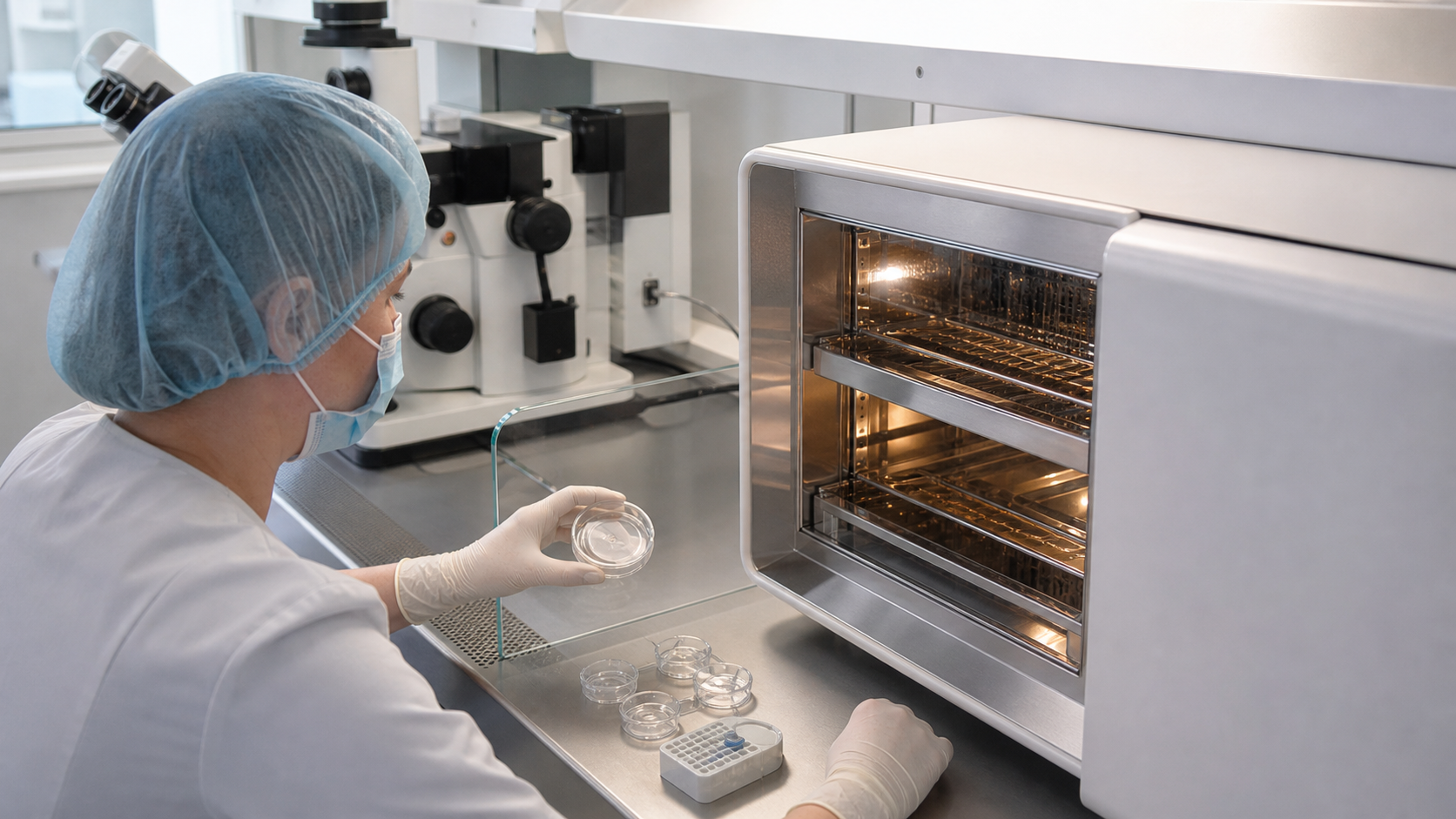
Smoke pattern testing can support better workstation layout for procedures such as gamete handling, media preparation and dish setup. It helps teams decide where to place warming surfaces, pipettes and waste containers so that first air to the critical area is preserved. In sensitive workflows, this can improve both sterility assurance and operator ergonomics.
When to use smoke pattern testing
A useful time to perform smoke testing is immediately after installation or relocation, before the cabinet enters routine service. It is also sensible after changes to room ventilation, furniture layout or workflow that may influence surrounding air movement.
Many laboratories also benefit from repeating the test after introducing new accessories or equipment inside the cabinet. If contamination trends, unexplained culture issues or user concerns arise, airflow visualisation can be a practical troubleshooting step. It helps distinguish between technique problems, layout problems and cabinet performance problems.
How to get meaningful results
For the test to be useful, it should reflect real operating conditions. The cabinet should be set up as it normally is, with typical materials, operator positioning and working heights. Watching airflow in an empty cabinet can miss the very factors that create disturbance during actual procedures.
Documentation also matters. Video recording can be helpful for training and for comparing before-and-after changes. If the test identifies an issue, corrective actions should be specific: reducing internal clutter, repositioning equipment, adjusting room airflow, limiting traffic near the cabinet or retraining users in slower, less disruptive movements.
A training tool, not just a technical exercise
One of the strongest reasons to use smoke pattern testing is education. Many cabinet errors are behavioural rather than mechanical. When users see how quickly airflow can be disrupted, good practice becomes easier to understand and follow.
This can support more consistent habits across teams, especially in laboratories with multiple operators and mixed workloads. It reinforces practical rules such as keeping front and rear grilles clear, working well inside the cabinet, minimising unnecessary movement and avoiding sudden withdrawals of the arms from the work zone.
Turning visual evidence into better control
Smoke pattern testing is not a replacement for standards-based certification, and it should not be treated as a standalone pass-or-fail exercise. Its value lies in revealing how the cabinet, the room and the operator interact under real conditions.
For laboratory managers and senior staff, that makes it a useful part of risk control. It can sharpen user training, improve cabinet layout and provide evidence when reviewing contamination investigations or workflow changes. In short, it helps translate compliance into day-to-day control.
If needed, tech²ART can help laboratories assess biosafety cabinet use and practical airflow performance in the wider context of laboratory safety and workflow.